MemoryCustodian Review
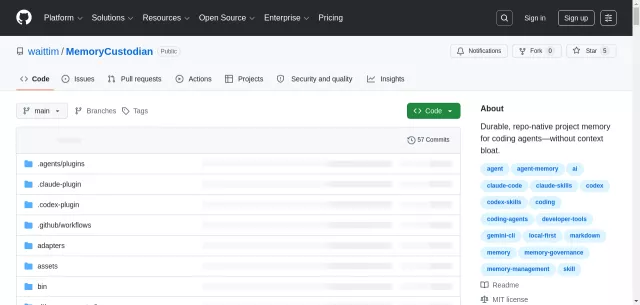
MemoryCustodian is a game-changing tool designed to empower coding agents with durable, repo-native project memory, eliminating the pervasive issue of context bloat. It allows your AI collaborators to remember crucial project details – decisions, constraints, rejected ideas, and overall project context – across sessions, agents, and teams. Instead of forcing agents to relearn or constantly re-process massive prompts, MemoryCustodian stores this invaluable institutional knowledge as plain Markdown directly within your repository, loading only the task-relevant pieces when needed. This means your agents start productive, every time, without repeating foundational work.
MemoryCustodian’s Edge
MemoryCustodian redefines how coding agents interact with project knowledge, offering a lean, efficient, and transparent memory layer. Key capabilities include:
- Repo-Native Durability: Memory lives as plain Markdown in your repository (e.g., in
docs/memory/), making it inspectable, diffable, committable, and roll-backable like regular code. - Minimal Context, Maximum Efficiency: Agents load only what’s essential for the current task via a
manifest.md(e.g.,brief.md,decisions.md,constraints.md,do-not-use.md). No more feeding massive context windows for every single query. - Persistent Project Context: Captures critical architectural constraints, preferred workflows, and historical decisions, preventing agents from re-evaluating established paths.
- Cross-Agent & Cross-Session: Ensures consistent understanding and progress whether you’re using Codex, Claude Code, Gemini, or other agents, and across multiple work sessions.
- CLI-Driven Governance: Provides a command-line interface for managing memory (add, forget, compact, check), ensuring structure and adherence to budgets, built with Python stdlib for offline use.
Who Benefits?
MemoryCustodian is an essential addition to the toolkit of anyone leveraging coding agents in their development workflow. Specifically, it’s tailored for:
- Developers & Teams: Who want their AI coding assistants to be more efficient, less repetitive, and better aligned with project history and best practices.
- AI Agent Builders: Providing a robust, transparent, and durable memory layer for their agents without resorting to complex RAG or vector database solutions for core project knowledge.
- Open-Source Projects: Where shared understanding and historical context are paramount, and memory needs to be version-controlled and easily accessible.
| Key Advantage | How MemoryCustodian Achieves It |
|---|---|
| Durable Project Memory | Stores decisions, constraints, and rejected ideas as version-controlled Markdown in your repo. |
| Reduced Context Bloat | Loads only task-relevant memory segments via a manifest, avoiding unnecessary prompt length. |
| Cross-Agent Consistency | Ensures all coding agents have access to the same, up-to-date project knowledge. |
| Human-Readable & Maintainable | Memory lives as standard Markdown, easily reviewed, diffed, and managed by developers. |
Top Alternatives to MemoryCustodian
Let’s explore and discover the best alternatives and similar tools to MemoryCustodian, carefully selected and ranked based on functionality, reliability, and user experience.