heal.dev Review
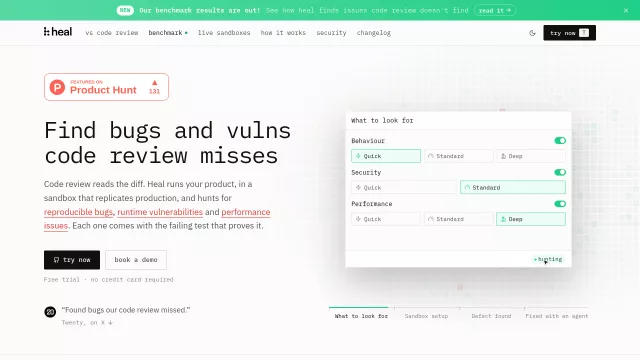
Heal.dev is the ultimate bug hunter for software teams, finding what traditional code reviews and static analysis miss. Instead of just “reading the diff,” Heal actively “runs your product” in a production-like sandbox. It uncovers reproducible bugs, runtime vulnerabilities, and performance issues, each delivered with a concrete, failing test.
Main Features
- Production Sandbox: Replicates your live environment, including mocked/emulated external services (payments, APIs) for holistic testing.
- Runtime Issue Detection: Goes beyond patterns. Heal executes real exploits and navigates flows to prove vulnerabilities or reveal subtle bugs.
- Reproducible Defects: Every issue includes a verifiable failing test case, accelerating diagnosis and fix validation.
- Comprehensive Scope: Catches behavioral bugs, runtime security flaws, performance bottlenecks, and missing routes.
Main Target
Heal.dev is for development teams committed to shipping robust, secure, and performant software. If your current QA — code reviews, E2E tests, static scanners — misses hidden runtime issues, edge cases, or unverified security, Heal fills those voids.
It’s especially beneficial for:
- Teams needing to expose issues between code, config, data, and third-party service interactions.
- Developers seeking clear, reproducible bug reports with failing tests.
- Organizations validating security exploits in a controlled, production-mirrored environment.
Here’s how Heal stands apart:
| Aspect | Code Review | Heal.dev |
|---|---|---|
| Methodology | Reads the diff. | Runs the full product in sandbox. |
| Scope | Limited to PR changes. | Covers entire product (features, data, services). |
| Verification | Flags patterns, relies on manual review. | Proves issues with failing, reproducible tests. |
Top Alternatives to heal.dev
Let’s explore and discover the best alternatives and similar tools to heal.dev, carefully selected and ranked based on functionality, reliability, and user experience.