witr Review
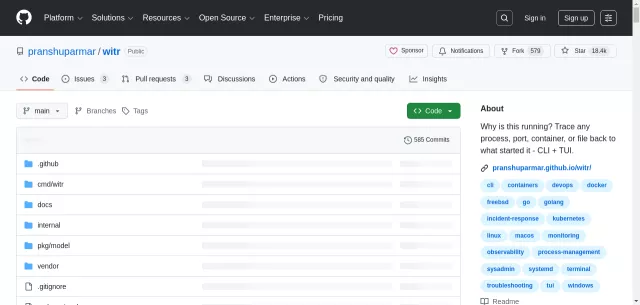
Ever found yourself deep in the terminal, wrestling with an elusive process, a mystery port, or a container acting up, all while muttering, “Why is this running?” You’re not alone. While stalwarts like ps, top, and lsof are indispensable for showing *what* is currently active, they often leave you in a state of manual correlation, stitching together fragmented clues to decipher the true origin story. Say hello to witr (pronounced “wĭt-er”), the open-source CLI and TUI tool engineered to be your detective for system causality. It doesn’t just show you the state; it unravels the exact chain of events that brought a resource into existence.
Main Features
- Causal Chain Revelation: From a single command or an interactive TUI, witr traces any process, port, container, or file back to its precise parentage – whether it’s a systemd unit, a Docker orchestration, or an arcane bash script.
- Interactive TUI Dashboard: Launching witr without arguments gives you a vibrant, real-time terminal dashboard. Explore processes, open ports, running containers (across Docker, Podman, K8s, etc.), and even system-wide file locks, all with rich detail views and filtering.
- Ubiquitous Compatibility: Engineered for the modern tech stack, witr provides full feature support across Linux, macOS, Windows, and FreeBSD, leveraging native APIs for speed and accuracy.
- Context-Rich Diagnostics: Beyond the ancestry, delve into environment variables, working directories, Git repository details, bind addresses, and even flags for potential security warnings like dangerous Linux capabilities or public-facing ports.
- Developer & Sysadmin Friendly: Whether you prefer human-readable explanations, machine-parseable JSON for scripting, or a concise ancestry tree, witr adapts, empowering seamless integration into incident response or daily ops.
Main Target
witr is an essential addition to the toolkit of any DevOps engineer, system administrator, or developer grappling with complex system behaviors. It’s built for those moments when you need to understand *how* a process started, *what* is keeping it alive, or *where* it truly belongs within your system’s intricate ecosystem. By making causality explicit and reducing the dependency on a myriad of fragmented tools, witr ensures that “Why is this running?” is no longer a question that leads to a rabbit hole, but one that leads to immediate, clear, and actionable answers, even under the pressure of an active incident.
| Traditional Tool Limitation | witr’s Causal Power |
|---|---|
| Shows what is running (current state) | Explains why it’s running (causal ancestry) |
| Requires manual correlation across tools | Provides explicit causality in one consolidated view |
| Leaves users to infer origins and dependencies | Reveals how it was started and what supervises it |
Top Alternatives to witr
Let’s explore and discover the best alternatives and similar tools to witr, carefully selected and ranked based on functionality, reliability, and user experience.