OpenShip Review
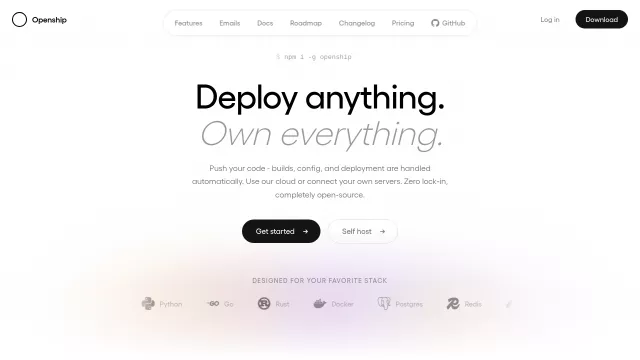
OpenShip is an innovative open-source, self-hostable Platform as a Service (PaaS) designed to give developers ultimate control over their deployments. It allows you to ship web applications and services to your own servers or chosen cloud environment with zero vendor lock-in. Embodying “Deploy anything, own everything,” OpenShip provides a robust, flexible, and transparent platform where you retain full ownership from code to infrastructure.
Main Features
OpenShip is packed with powerful capabilities engineered for efficiency, flexibility, and developer freedom:
- Self-Hostable & Open Source: Run the entire platform on your machines for free, forever, under the Apache 2.0 license. Full transparency and auditability.
- Effortless Automated Deployment: Push-to-deploy from Git, CLI, or desktop app. Auto-detects popular stacks like Next.js, Python, Go, Rust, and Docker, handling builds and config automatically.
- Robust Operations: Instant rollbacks to any previous version, zero-downtime deploys, and free auto-renewing SSL for unlimited custom domains.
- Integrated Managed Services: Access essential services like managed PostgreSQL, Redis, a full Mail Server, and S3-compatible object storage on an isolated private network.
- Versatile Management: Control deployments via a powerful CLI, intuitive web dashboard, native desktop app, or integrate with AI agents through the MCP server.
- Zero Vendor Lock-in: Applications are standard Docker containers, streaming over SSH. Easily migrate workloads between OpenShip Cloud and your own servers with a single click.
Main Target
OpenShip is ideally suited for users who prioritize control, flexibility, and open standards:
| Developers & Teams: | Seeking comprehensive control over their CI/CD pipeline and actively moving away from vendor lock-in. |
| Open Source Advocates: | Value software transparency, the ability to inspect, audit, modify, and contribute to their tools. |
| Budget-Conscious Businesses: | Looking for powerful deployment capabilities without recurring platform fees for self-hosted instances. |
| Security-First Organizations: | Prioritizing data residency, isolated private networking, and granular access control for maximum security. |
By offering a compelling, feature-rich alternative to traditional managed PaaS platforms, OpenShip empowers its users to reclaim ownership and flexibility in their application deployments.
Top Alternatives to OpenShip
Let’s explore and discover the best alternatives and similar tools to OpenShip, carefully selected and ranked based on functionality, reliability, and user experience.